How to Sew a Split Nine Patch Quilt Block Using 5" Squares
Updated: Sep 2
Sew a Split Nine Patch Quilt Block
The split nine patch is one of those brilliant quilt blocks that looks simple on its own, but becomes really exciting once you start making more of them.

It is made just like a basic nine patch block, but with a few half square triangles added in. When the blocks are repeated and turned in different directions, you can create diagonal lines, zig zags, diamonds, barn raising layouts and lots of lovely scrappy movement.

This is a great block for using up 5" squares, charm packs or leftover fabric from other projects. You can keep it really controlled with two colours, or go completely scrappy with a mix of lights and darks.
Finished block size
Using 5" squares, this block will finish at approximately 12" square once sewn into a quilt.
The unfinished block will measure 12½" square.
You will need for one block
For each split nine patch block, you will need:
4 dark 4.5" squares
3 light 4.5" squares
2 dark 5" square for making half square triangles
2 light 5" square for making half square triangles
You will also need:
Rotary cutter
Quilting ruler
Cutting mat
Fabric marker or pencil
Sewing machine
Thread
Iron
Pins or clips
Before you start
For this block, the most important thing is contrast. You need some fabrics that read as light and some that read as dark, so the split effect shows up once the blocks are joined together.
They don’t all need to match perfectly. In fact, this block looks lovely when it’s a bit scrappy. Florals, ginghams, dots, stripes and little prints can all work together as long as you have a good mix of light and dark fabrics.
Use a ¼" seam allowance throughout.
Step 1: Make the half square triangles
Take one light 5" square and one dark 5" square and place them right sides together.
Draw a diagonal line from one corner to the opposite corner on the wrong side of one square.

Sew ¼" away from each side of the drawn line.

Cut along the drawn line to separate the two pieces.

Open out each half square triangle and press the seam towards the darker fabric.
Trim each half square triangle to 4½" square.

You will have two half square triangles from this pair.
Repeat with another light and dark 5" square to make multiple blocks and save the spare half square triangle for another block.

For one split nine patch block, you will need 2 half square triangles in total.
Step 2: Trim the plain squares (for charm packs)
Trim your plain 5" squares down to 4½" square
For one block, you need:
3 light 4½" squares
4 dark 4½" squares
2 half square triangles measuring 4½" square
This gives you 9 units in total, ready to arrange into a nine patch block.
Step 3: Lay out the block
Arrange your units into three rows of three.
Place the half square triangles in opposite corners of the block, so they create a split between the light side and the dark side.
A simple layout is:
Top row: half square triangle, light square, light square
Middle row: dark square, dark square, light square
Bottom row: dark square, dark square, half square triangle

Make sure the darker triangles all point towards the dark side of the block, and the lighter triangles all point towards the light side.
This creates the classic split nine patch look.
Step 4: Sew the rows
Sew the three units in the top row together.
Repeat for the middle row and bottom row.
Press the seams in opposite directions for each row if you can. This helps the seams nest together when you join the rows.
For example, press the top and bottom row seams one way, and the middle row seams the opposite way.

Step 5: Join the rows
Place the top row and middle row right sides together.
Match the seams carefully, then sew together using a ¼" seam allowance.
Repeat to add the bottom row.
Press the block flat.
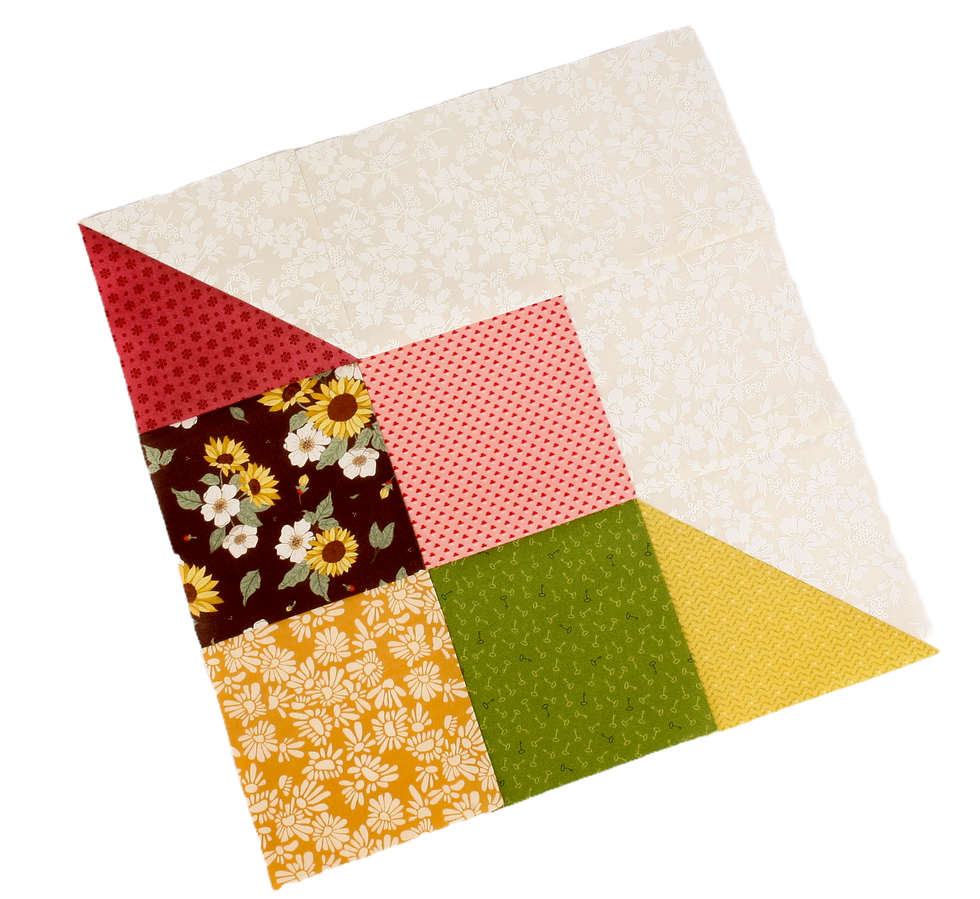
Your split nine patch block is finished.
Play with the layout
The fun part of this block really starts when you make a few of them.
Try rotating the blocks before sewing them together. You can create diagonal stripes, zig zags, diamonds, squares, arrows and barn raising style layouts just by turning the blocks in different directions.
If you are making a quilt, lay all the blocks out on the floor or a design wall first and have a play before sewing anything together. Take a photo of your favourite layout so you don’t forget where everything goes.

Tips for a neat finish
Trim your half square triangles carefully so they are the same size as your plain squares.
Use a consistent ¼" seam allowance.
Press as you go, rather than waiting until the end.
Don’t worry if your block is a little bit scrappy or imperfect. This is a lovely forgiving block, especially when made into a full quilt.
Quilt ideas using this block
This block would make a beautiful scrappy quilt using charm squares from your stash. You could use low volume fabrics for the light side and florals or ginghams for the dark side.
For a softer cottage style quilt, try creams, pale blues, pinks, greens and tiny floral prints.
For a bold version, use a plain background fabric with bright scraps for the darker side.
You could also make just one block and turn it into a cushion, mini quilt, tote bag panel or table mat.
Want to Make a Smaller Block?
You can also make a smaller version of this split nine patch block, which is perfect for mini quilts, patchwork bags, pouches, cushions, pockets and smaller quilted projects.
Instead of using 4½" units, use 2½" squares and 2½" half square triangles.

For one smaller block, you will need:
3 light 2½" squares
4 dark 2½" squares
2 half square triangles trimmed to 2½" square (start with two light 3" square and two dark 3" square to make 4 HSTs - save 2 for a second block)
Arrange the pieces in the same way as the larger block, with the half square triangles running diagonally through the centre.
Because each 2½" unit finishes at 2" once sewn, your finished block will measure 6" square when sewn into a project.
The unfinished block will measure 6½" square.
This size is really handy if you want to use the block as a feature panel. Four smaller blocks sewn together would make a lovely 12" finished patchwork panel, which could be used for the front of a cushion, a tote bag pocket, a mini quilt or the front of a quilted pouch.
It’s a lovely way to use tiny scraps too. Just keep a good mix of light and dark fabrics so the split design still shows up clearly.
The split nine patch is a simple block with lots of possibilities. It’s easy enough for beginners, uses basic squares and half square triangles, and is a brilliant way to turn scraps or charm squares into something that looks much more detailed than it actually is.
Once you’ve made one, you’ll probably want to make a whole pile and start turning them in different directions to see what patterns appear!
Find your next project


If you’re looking for your next project, you can find more of my quilt patterns and sewing patterns in the shop. I’ve got everything from simple patchwork projects to larger quilts, with step-by-step instructions to help you turn all that quilt block practice into something finished. Browse the sewing patterns here →
Happy Sewing, Kym


Comments